Wednesday, July 29, 2009

Many European lives saved by Hawaiians

I have already mentioned that the Hawaiians were deemed ever valuable due to thier canoeing and swimming skills, but I found out a little more details of how important those skills were. I guess the French were considered top notch in canoe handling, but they weren't so keen on swimming, so if a canoe flipped, both the men and the equipment were lost. The Hudson Bay Co stationed a Sandwich Islander on every French canoe as a life-guard more or less. Not only were they able to save the floundering Frenchmen, but they often dove to rescue the equipment too.
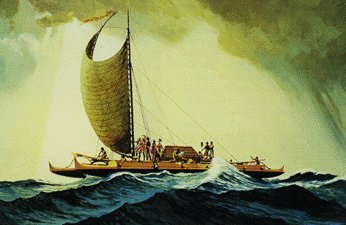
Many Hawaiian canoes often had sails which made them great candidates for deckhands on the European and American ships. There could navigate both open water and inland rivers. Photo

Sunday, July 26, 2009

One step closer to final timeline.....

Most of the workers who came from Hawaii were young men who were brought on board by American and European explorers. It was a common practice for these men to marry Native American wives. The Hudson Bay Co. recognized that they were able to retain good Hawaiian labor when these unions formed. Beginning in 1829, Catholic priests began officiating the marriages between them. The wives of the Hawaiians worked in processing of foods, and also making goods for trade.

Joseph Poalie Friday was a Kanaka (Hawaiian) who Friday Harbor is named after. He worked as a "general laborer" for Hudson Bay Co. starting in 1841 and for quite some time, he was the only resident of Friday Harbor. Friday made several trip to and from Hawaii and the NW region. There seems to be much confusion reguarding Joseph Friday, it is suspected that the Peter Friday, a man recorded in the 1880 census was the same man. He married a Native American women which he had children with, the eldest son's name was Joseph.


Sources: Park Services, Joe Friday

Thursday, July 23, 2009

"Old Coxe" or Naukane


Coxe was a "sandwich islander" who was brought to the Pacific NW by David Thompson, a Canadian explorer. He was the first Hawaiian to visit the Spokane house, Coxe spent the winter of 1811 there. He meant many explorers, trappers and frontiersmen, and each seemed to think highly of him. "Bold and trustworthy," "anxious to aquire our language" are words his fellow travellers used to describe him. He also was helpful in canoe making, and his stature made him easily power through hard physical labor.

Coxe's origional name was Naukane. He was the son of a Hawaiian king. He travelled to England as part of the royal court of the current king and queen of the Kona coast in 1823. Sadly, 5 of the people in his party died of smallpox while on their journey, including his and her majesty. When Coxe returned to Hawaii, people suspected him foul play. He ended up moving permanently to the mainland where he settled near Fort Vancouver. He was a long time employee of the Hudson Bay Co. and was buried in their cemetery in 1850.
Painted by Paul Kane


Sunday, July 19, 2009

More about Hawaiians in the Pacific NW 1825


-Hawaiians in the Pacific Northwest were given names such as Owyhees or Kanakas, which meant indigenous Sandwich Islanders. The Tonquin that I mentioned in a previous post actually brought 24 Islanders along to the Columbia.


Fort Vancouver was "home" to hundreds of Owyhees. The King of Hawaii at the time made a deal with the British to "hire" the Hawaiians as indentured servants. They worked in sawmills, agriculture, fishing ect. They even created their own small community right outside of Fort Vancouver called Kanaka Village.

Sketch: of Kanaka Village By George Gibbs
Sources: The Fur Traders and The Hawaiians 1825


Schwantes, Carlos. The Pacific Northwest: an Interpretive History

Monday, July 13, 2009

Washington and Hawaii: More History 1788


Alright, so these are not exactly in chronological order, but here goes more info for my potential final project: Captain Robert Gray sailed from Boston to the Washington region where he spent time exploring the coastline and founded Grays Harbor. On his way back to Boston, his ship, The Columbia stopped at the Hawaiian island to obtain supplies for the voyage east.


There, he "enlisted a Hawaiian servant" named Attoo, who was 17 years old. It is speculated that Attoo on a returning trip to the NW was able to diffuse a situation between he Nootka Indians and Gray's men which ultimately saved their lives. Hawaiians and early white settlers seem to have a long and important history together.


Botanist and a Man with Sand:1825


    David Douglas was a Scotland native who worked in Scotland and England in multiple botany and horticultural divisions. He explored nature from California to Puget Sound on many trips to and from England. In 1825, he was the first to document a climb up the Cascade Mountains and to witness the distinctly different climates Washington offered. The younger brother of a local tribes chief as his guide, they partook in an intensive climb. 

   Douglas considered this ascent to be one of the "most laborious undertakings I had ever experienced." Though others may have used the name conversationally, he was the first to give the Cascade Mountains the name on paper. His records helped others who were settling in the area. Additionally, he was recognized for introducing over 200 species of plant life to England from America, and found and recorded the Douglas Fir, which, clearly is named after him. (Which is also Oregon's state tree, thanks Cole.) 

The David Douglas Archives: A Collection of Historical and Genealogical Records.

Sunday, July 12, 2009

Chief Sealth and Pac NW tribes

Alright, this is really hard to see, but heres the link so you guys can check it out: NW Tribal Territories . There appear to be 2 tribal maps, on of the Plateau tribes, and another of the Northwest Coast ones. I did some research on Chief Sealth, or Seattle, since his grave is close to my grandfathers house on Bainbridge Island. Chief Seattle was born after the infulence of Westerners had already taken it's toll. Disease and violence had already began to diminish the Native American population. He was born of noble blood and owned slaves as his father and thier ancestors had.


He enters the written historical records not until 1833, the Hudson Bay company reguarded him as "Le Gros" which meant "the big one" which descibed his status as well as his leadership style. This site content.lib.washington.edu is part of UW's libriary "digital collection." It has a ton on info on NW native american history.


I think Chief Seattle would be an intersting person to do more research on. He and his father Schweabe was from the Suquamish tribe, and his mother Sholitza was from the Duamish tribe, this family was all very local.

Friday, July 10, 2009

Hawaiians, co founders of the Puget Sound Region


In 1811, 2 dozen native Hawaiians from Honolulu signed on with captain Thorn and boarded the Tonquin to explore the Northern parts of the Pacific. I found an article from the Papers of the Hawaiian Historical Society that spoke of the long standing relationship between Northwest explorers and local islanders.

These documents quote a member of the Tonquin saying in reference to the Hawaiians that they "were remarkable for their skill in managing light craft and able to swim and dive like waterfowl." For the explorers, they were cheap labor, they signed on for 3 years for food and board, and $100 in "merchandise" at the end of their service. This seems like a pretty unfair trade considering their level of experience in the marine field, but exploitation of native people is nothing new in history!