Thursday, August 13, 2009

Bibliography and an assortment of my Hawaii pictures


Sources:


Barman, Jean & Watson, Bruce. Leaving Paradise: INdigenous Hawaiians in the Pacific Northwest 1787-1898. University of Hawaii Press: Honolulu 2006


Duncan, Janet. Minority without a Champion: Kanakas on the Pacific Coast 1788-1850. Times-Litho Printers: Portland 1972

Hawaii: A History of the Big Island, Robert Oaks-Google Books


Hawaiian History in Vancouver-Google Newspaper: Vancouver Voice


Historylink.org essay number 8413


Koppel, Tom. Kanaka: The Untold Story of Hawaiian Pioneers in British Columbia and the Pacif Nothwest. Whitecap Books: Vancouver 1995


MythicHawaii.com: Captain Cook Discovers Hawaii


Summary of Kanakas 1778-1850

The Kanakas were without a doubt, an indispensable piece of the Pacific Northwest's history. Surveyors, explorers, pioneers, and entrepreneurs all relied heavily on the labor that these native Hawaiians were ready and willing to provide. Even the American Board of of Commissioners for Foreign Missions hired Kanakas to help build their churches, missions,and Christian schools. Methodist, Evangelists, Protestants and other Christian denominations can attribute much of their presence in the Northwest to the Sandwich Islanders.

It is not certain what led so many of them to our region, but we are fortunate they did. Unfortunately, as our state developed and became more populated and "civilized," our appreciation for the Kanakas dissipated. They, like the Native Americans, Chinese, and African Americans during that time frame became more and more inferior to the Whites they had previously had positive relationships with.


Kankas Head South to California-1849

The dream of striking it rich drew many of the Kanakas down to California once thier contracts with HBC expired. John Sutter publicly praised the Kanakas for their hard work and help settling the area of Sacramento. Though many of the Kanakas went to mind gold, salmon fishing was another service that Hawaiian workers often supplied in California. At one point in the mid nineteenth century, Kanakas made up a quarter of the population in San Francisco.

A few of some of the longest serving Hawaiians stayed near the forts of the HBC as free men, many had married Native American women and had several children. Those who remained became eligible to buy land in the same fashion as their white counterparts. The conditions were to improve the land, take an oath of loyalty to the government, and pay about a dollar per acre. For the most part, the Hawaiians stayed in mixed communities of Islanders and Native Americans. Even as they purchased land, the plots were adjacent to one another.

Sources: Gold Mountain

Google Books


Wednesday, August 12, 2009

Hawaiians as Contracted Workers of HBC-1823

Eventually, in 1821 the Hudson Bay Company acquired The Northwest Company and all of it's Kanaka laborers. New employees were being signed on as workers for the company. In 1825, George Simpson, the head of the North American division of HBC raised the Kanaka's wages to those equal of the Canadians. He considered them a highly valuable asset to the company's success.
In 1828, Simpson attributed the success of the new Fort Langley on the Frasier River mostly to a group, including 3 Kanakas who had been sent 4 years prior to scout out the best for it and begin to construct it. The records from Fort Langley all support the idea that Kanakas were both physically and mentally capable workers. According to John McLoughlin, who was responsible for hiring many of the Hawaiian workers, they tended to be harder workers than much of the French Canadian and Native American individuals they employed, and they seemed to be resistant to many illnesses.
The Kanakas in the NW helped to survey new land, clear it, and build new posts and forts. They helped to navigate journeys from Hawaii to the Northwest. They had great skill in canoe making as well as maneuvering ships through the harsh waters near the Columbia. Without them, the British exploration into the NW would have been severely delayed.
HBC set up an office in Oahu in order to help keep trade efficient from the islands to the mainland. Timber and salmon were some of the main exports from the NW forts to Hawaii, while sweet potatos, hogs and coconuts were the primary imports.
Sources: Leavings Paradise: Indigenous Hawaiians in the Pacific NW
Kanaka Timeline *This is a great supplement to my timeline

Old John Coxe 1811

Photo from historylink.org
John Jacob Astor was a very wealthy and successful business man from New York who created the Pacific Fur Co. In 1811, he sent a crew of 33 men, and Captain Johnathan Thorn to the Northwest with a scheduled stop in Honolulu. When the boat made it's first stop, many of the crew were fed up with their captain, who ran his ship like a dictator, and deserted him. Thorn replaced many of his men with local Hawaiians and at least a dozen of them headed to the mouth of the Columbia later that year. Thorn and the origional crew were impressed with the Kanakas ablities both on deck and in the water, they were avid swimmers and were able to prevent losses of men and equipment.
King Kamehameha of Hawaii sent Nukane to be a royal observer of the happennings in Astoria. Soon, his took on the nickname John Coxe, which stayed with him for the rest of his life. At some point in his journey, Coxe was traded by the Paficic Fur Co. to the Northwest Trading Co. for a Canadian who was familiar with the Indian population in the area. Coxe became a companion with famous surveyor and map maker David Thompson. Together they reached the Spokane House in 1811.
Coxe became loyal to the British company, and when the war of 1812 broke out, he travelled to England to gather necessary supplies and men to take over the American fort in Astoria only to discover when he returned in 1813, that Astor had already made a business deal and sold the company to the British. He remianed at the fort for another year before returning to Hawaii.
In 1826, Coxe settled in the NW for good. He was the first Kanaka to travel the interior of Washington terriory. He helped famous He became a long time employee of HBC and ended up being a hog farmer and herder. He became a free man no longer employed by anyone in 1843, and stayed in the Vancouver area until his death in 1850.
Koppel, Tom. Kanaka: The Untold Story of Hawaiian Pioneers in British Columbia and the Pacific Northwest. (21)

Monday, August 10, 2009

John Matauray-1789


By Raymond Massey: Princess Royal off Kuai Coast

John Matauray was part of the royal family of Ni'ihau. He came with Captain James Colnett first on the Princess Royal, and then on the Argonaut which he sailed to the Northwest on. He was not only a guest on the ship, but also a great deckhand, at one point, he actually dove off the boat into the ocean after it began taking on water and discovered the leak in it's side.
Matauray had only been in the Northwest for a small amount of time before Spaniards accosted him and all of Colnett's crew. They were brought to a Spanish fort in San Blas off the coast of Mexico. The Spanish assumed that Matauray was taken unwillingly from his home, so they attempted to hold him in their custody after the release of Colnett's men. Eventually, with the help of the captain, Matauray was able to personally negotiate with the Spaniards to let him sail back to his family and home with Colnett on the Argonaut.
He sailed back and reached Washington's coast for his third and final time in 1790. He died of unknown causes. Colnett held Matauray in the highest regards, and their mutual friendship did not go unappreciated by the Hawaiian Islander. Before he died, he wrote a note of gratitude to Colnett for "all the good I had done him, and meant to do him." (Barman & Watson, 25) Matauray was known for being a quick learner and having a gift with speaking multiple languages.

Timeline Link

Here is a timeline of some of the important points in the history between the Northwest and Hawaii. Click here.

Winee and Kaiana -1787


Winee sketched by a crew member of John Meares


Winee was the first Kanaka to be recorded visiting the Northwest. She came aboard the the Imperial Eagle, a British ship captained by Charles Barkley. She was a servant and companion to his wife Frances. She was also the first Hawaiian to be documented leaving their home in the Islands. Winee travelled with the ship north where they hunted for otter pelts in the Puget Sound Region. Once Barkley felt they had a substantial amount, they headed to China where the pelts were being exchanged nearly $100 each.

By the time they arrived, Winee was both ill and homesick and wanted to return to her home in the tropics, so the Barkleys left her in China as they sailed on to Europe. Fortunately, Winee managed to connect with another globe trotting Kanaka, Kaiana. (He was also referred to as Tianna.) Kaiana, who was a chief of the islands had arrived in China with Captain John Meares aboard the Nootka. Both Hawaiians followed Meares onto the Felice Adventurer in 1788 that would head for the Philippines, and then back to the Sandwich Islands.
Sadly, before returning home, Winee died of her illnesses. She left most of her belongings to Kaiana, and gave him specific instructions to return the rest of her possessions to her family. Kaiana continued on and ended up in the Northwest region essentially by mistake. On the journey from the Philippines to Hawaii, the ship had to stop for emergency repairs in Washtington territory.

Kaiana didn't reach home until December of 1788, where he was met with a very hostile reception. While away, "an inhuman proscription had been published threatening him with instant death." (Barman & Watson)The only reason he was not killed was because of an alliance previously formed with the prince of the big Island of Hawaii. Unfortunately, this alliance only lasted temporarily, because Kaiana was killed by the prince on Oahu in battle in 1795.
Sources: Duncan, Janice. Minority without a Champion: Kanakas on the Pacific Coast. Times Litho Printers: Portland, 1972.


Sunday, August 9, 2009

James Cook-1778

(Death of James Cook National Maritime Museum)
~James Cook arrived in Hawaii in 1778 aboard the HMS Resolve along with the Discovery. They made their first contact with the island's natives off the coast of Kauai. This was the first European contact recorded, and the Hawaiians deemed Captain Cook and his crew as a non threatening. These were very fortunate circumstances as the 2 ships were running low on supplies, and their final destination, the Northwest Passage was still over 2,500 miles away.

~ While there, the ships crewman traded brass items for fish, fresh water, and other necessary supplies.

~Cook's previous travels though the South Pacific made him experienced with the ancestors of the Hawaiians. He regarded the native Polynesians in a generally positive manner and found the islanders too be similar in manner. He also found that they could be thieves.

~ Cook named the Hawaiian Islands the "Sandwich Islands" after an English Noble.

~ In 1779, Cook was killed by the Hawaiians after a ship of
his had been stolen and robbed. The exact incident seems to be still in debate.


Early explorers of the Pacific Northwest Coast and Native Hawaiians

P1.
Since the late eighteenth century, Hawaii has acted as a mid point for
the Northwest's earliest explorers. The geographical location of the Hawaiian
Islands made it the perfect place for both European and American adventurers
to stop for supplies before heading north toward Washington Territory where the fur
trade soon exploded. Soon, Hawaiian natives became prime sources of labor for trading
company's. Whites referred to the Hawaiians as sandwich islanders, Kanakas and Owyhees.
(Photo by April, July, 2009. Kauai Coast)


Tuesday, August 4, 2009

First Hawaiian in the Pacific NW

The Imperial Eagle 1787 off Ka'ena Point


So, turns out that a Hawaiian woman named Winee was the first Sandwich Islander to be recorded in the NW around 1788. She arrived on the British Ship The Imperial Eagle, with captain Charles Barclay. Winee was aquired as a "companion/servant" for his wife Francis. Short post, but an important one. Winee was the first Native Hawaiian to be documented leaving the Islands.
Duncan, Jamice. Minority without a Champion: Kanakas on the Pacific Coast

Sunday, August 2, 2009

Pac NW and Hawaiian Connection


I decided it may be a good idea to revisit Fort Vancouver and the Hawaiians that inhabited. While searching, I learned that the Sandwich Islands were the mid point between Asia and the Pacific NW. During the exploration and settling of the area, one of the busiest ports in the world was in Hawaii. It was SO busy ,that the Hudson Bay Co. established an office in Oahu in 1829. There, they were able to manage the importing and exporting of goods, such as hogs, sweet potatoes, and sugar to the NW.
Fort Vancouver 1825


Much like the Native Americans, the Native Hawaiian's sufferred from disease as contact with Europe and Asia increased. This was part of the reason that many left the islands to explore abroad. Some however were forced or coerced into indentured servantry.


Wednesday, July 29, 2009

Many European lives saved by Hawaiians

I have already mentioned that the Hawaiians were deemed ever valuable due to thier canoeing and swimming skills, but I found out a little more details of how important those skills were. I guess the French were considered top notch in canoe handling, but they weren't so keen on swimming, so if a canoe flipped, both the men and the equipment were lost. The Hudson Bay Co stationed a Sandwich Islander on every French canoe as a life-guard more or less. Not only were they able to save the floundering Frenchmen, but they often dove to rescue the equipment too.
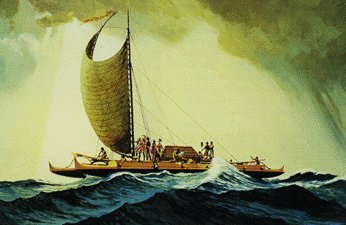
Many Hawaiian canoes often had sails which made them great candidates for deckhands on the European and American ships. There could navigate both open water and inland rivers. Photo

Sunday, July 26, 2009

One step closer to final timeline.....

Most of the workers who came from Hawaii were young men who were brought on board by American and European explorers. It was a common practice for these men to marry Native American wives. The Hudson Bay Co. recognized that they were able to retain good Hawaiian labor when these unions formed. Beginning in 1829, Catholic priests began officiating the marriages between them. The wives of the Hawaiians worked in processing of foods, and also making goods for trade.

Joseph Poalie Friday was a Kanaka (Hawaiian) who Friday Harbor is named after. He worked as a "general laborer" for Hudson Bay Co. starting in 1841 and for quite some time, he was the only resident of Friday Harbor. Friday made several trip to and from Hawaii and the NW region. There seems to be much confusion reguarding Joseph Friday, it is suspected that the Peter Friday, a man recorded in the 1880 census was the same man. He married a Native American women which he had children with, the eldest son's name was Joseph.


Sources: Park Services, Joe Friday

Thursday, July 23, 2009

"Old Coxe" or Naukane


Coxe was a "sandwich islander" who was brought to the Pacific NW by David Thompson, a Canadian explorer. He was the first Hawaiian to visit the Spokane house, Coxe spent the winter of 1811 there. He meant many explorers, trappers and frontiersmen, and each seemed to think highly of him. "Bold and trustworthy," "anxious to aquire our language" are words his fellow travellers used to describe him. He also was helpful in canoe making, and his stature made him easily power through hard physical labor.

Coxe's origional name was Naukane. He was the son of a Hawaiian king. He travelled to England as part of the royal court of the current king and queen of the Kona coast in 1823. Sadly, 5 of the people in his party died of smallpox while on their journey, including his and her majesty. When Coxe returned to Hawaii, people suspected him foul play. He ended up moving permanently to the mainland where he settled near Fort Vancouver. He was a long time employee of the Hudson Bay Co. and was buried in their cemetery in 1850.
Painted by Paul Kane


Sunday, July 19, 2009

More about Hawaiians in the Pacific NW 1825


-Hawaiians in the Pacific Northwest were given names such as Owyhees or Kanakas, which meant indigenous Sandwich Islanders. The Tonquin that I mentioned in a previous post actually brought 24 Islanders along to the Columbia.


Fort Vancouver was "home" to hundreds of Owyhees. The King of Hawaii at the time made a deal with the British to "hire" the Hawaiians as indentured servants. They worked in sawmills, agriculture, fishing ect. They even created their own small community right outside of Fort Vancouver called Kanaka Village.

Sketch: of Kanaka Village By George Gibbs
Sources: The Fur Traders and The Hawaiians 1825


Schwantes, Carlos. The Pacific Northwest: an Interpretive History

Monday, July 13, 2009

Washington and Hawaii: More History 1788


Alright, so these are not exactly in chronological order, but here goes more info for my potential final project: Captain Robert Gray sailed from Boston to the Washington region where he spent time exploring the coastline and founded Grays Harbor. On his way back to Boston, his ship, The Columbia stopped at the Hawaiian island to obtain supplies for the voyage east.


There, he "enlisted a Hawaiian servant" named Attoo, who was 17 years old. It is speculated that Attoo on a returning trip to the NW was able to diffuse a situation between he Nootka Indians and Gray's men which ultimately saved their lives. Hawaiians and early white settlers seem to have a long and important history together.


Botanist and a Man with Sand:1825


    David Douglas was a Scotland native who worked in Scotland and England in multiple botany and horticultural divisions. He explored nature from California to Puget Sound on many trips to and from England. In 1825, he was the first to document a climb up the Cascade Mountains and to witness the distinctly different climates Washington offered. The younger brother of a local tribes chief as his guide, they partook in an intensive climb. 

   Douglas considered this ascent to be one of the "most laborious undertakings I had ever experienced." Though others may have used the name conversationally, he was the first to give the Cascade Mountains the name on paper. His records helped others who were settling in the area. Additionally, he was recognized for introducing over 200 species of plant life to England from America, and found and recorded the Douglas Fir, which, clearly is named after him. (Which is also Oregon's state tree, thanks Cole.) 

The David Douglas Archives: A Collection of Historical and Genealogical Records.

Sunday, July 12, 2009

Chief Sealth and Pac NW tribes

Alright, this is really hard to see, but heres the link so you guys can check it out: NW Tribal Territories . There appear to be 2 tribal maps, on of the Plateau tribes, and another of the Northwest Coast ones. I did some research on Chief Sealth, or Seattle, since his grave is close to my grandfathers house on Bainbridge Island. Chief Seattle was born after the infulence of Westerners had already taken it's toll. Disease and violence had already began to diminish the Native American population. He was born of noble blood and owned slaves as his father and thier ancestors had.


He enters the written historical records not until 1833, the Hudson Bay company reguarded him as "Le Gros" which meant "the big one" which descibed his status as well as his leadership style. This site content.lib.washington.edu is part of UW's libriary "digital collection." It has a ton on info on NW native american history.


I think Chief Seattle would be an intersting person to do more research on. He and his father Schweabe was from the Suquamish tribe, and his mother Sholitza was from the Duamish tribe, this family was all very local.

Friday, July 10, 2009

Hawaiians, co founders of the Puget Sound Region


In 1811, 2 dozen native Hawaiians from Honolulu signed on with captain Thorn and boarded the Tonquin to explore the Northern parts of the Pacific. I found an article from the Papers of the Hawaiian Historical Society that spoke of the long standing relationship between Northwest explorers and local islanders.

These documents quote a member of the Tonquin saying in reference to the Hawaiians that they "were remarkable for their skill in managing light craft and able to swim and dive like waterfowl." For the explorers, they were cheap labor, they signed on for 3 years for food and board, and $100 in "merchandise" at the end of their service. This seems like a pretty unfair trade considering their level of experience in the marine field, but exploitation of native people is nothing new in history!


Friday, June 26, 2009

Emerging Puget Sound


Archibald McDonald was sent from Fort Vancouver to Puget Sound to create the first permanent European settlement in the area. In 1833, he settled in beside the Sequlitchew creek in the Nisqually delta. There, a fort was created, and shortly after, the Hudson Bay Co.'s Agrucultural Co. established the Cowlitz Farm. The farm came into possession of Americans in 1859.


Fort Nisqually is currently part of Pierce Co. and now a "living" historical museum. We could go tour it!


The Nisqually Delta Association was formed in 1973 after Weyerhauser bought up much of the land and planned to put a full fledged saw/pulp mill docks and other equipment there. The Nisqually Delta was turned into a wildlife refuge in 1974 to protect migratory birds. In general terms, the region, protected for it's wilderness and historical context has been a topic of activism throughout it's history.


Monday, June 22, 2009

Blog #1


    We are just wrapping up our first field trip day. We motored on Professor Young's sailboat along Alki, past the shipyard got a narrated tour of the waterfront of Seattle. (Thanks to Alex of course.) Having a greater understanding of the background of the waterfront has been very interesting. Particularly, that there was such controversy over the way that ferry boats signal each other as they are leaving coming and going from the ferry terminals. This has been a great day seeing the piers from an alternate perspective. 
   Other random info, Bell Town used to be part of the slums. This made me laugh because now it is the place to go and there are clubs and lounges and things that are considered upscale.